Homepage of Jeremy Wu 🇨🇦
Assistant Professor He/Him
307 St. Paul's College (Temporary home of the Department of Mathematics)
University of Manitoba
E-mail: jeremy (dot) wu (at) umanitoba (dot) ca
About
I am an Assistant Professor in the Department of Mathematics at the University of Manitoba.
I was a Postdoctoral researcher under the Hedrick Assistant Adjunct Professor position at UCLA in 2022-2025. My mentors were Inwon Kim and Wilfrid Gangbo.
I obtained my DPhil (PhD) in 2022 at the Mathematical Institute in the University of Oxford within the OxPDE research group. My PhD supervisors were José A. Carrillo and Matias G. Delgadino.
I obtained my MSci during my undergraduate studies from 2013-2017 at Imperial College London. Afterward, I obtained my MAst from 2017-2018 from the University of Cambridge.
Broadly speaking, I am interested in Partial Differential Equations with a focus in gradient flows, kinetic theory, their intersections, and related areas. Recently, I am interested in understanding discrete-to-continuous and micro-to-macro limits.
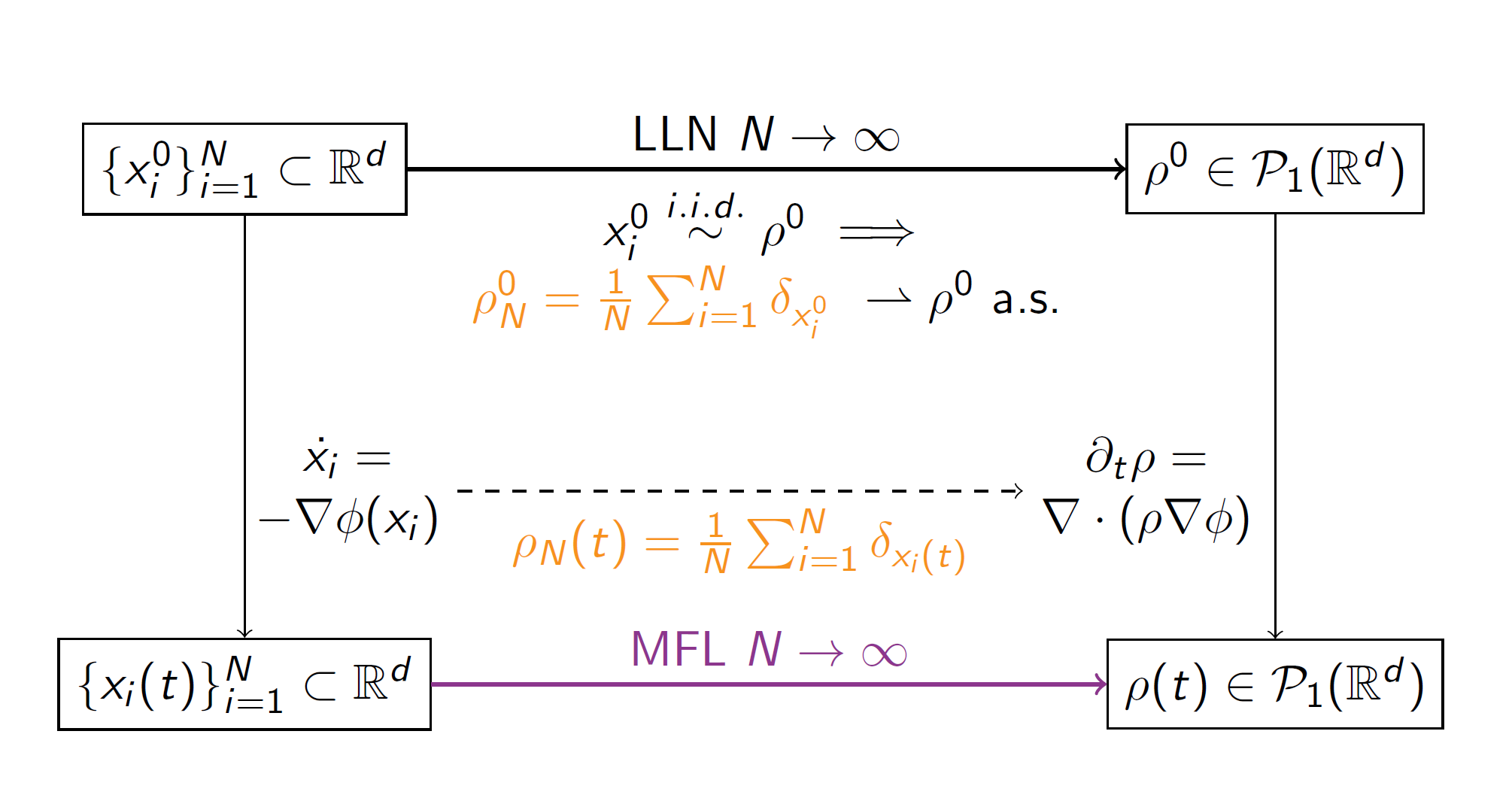
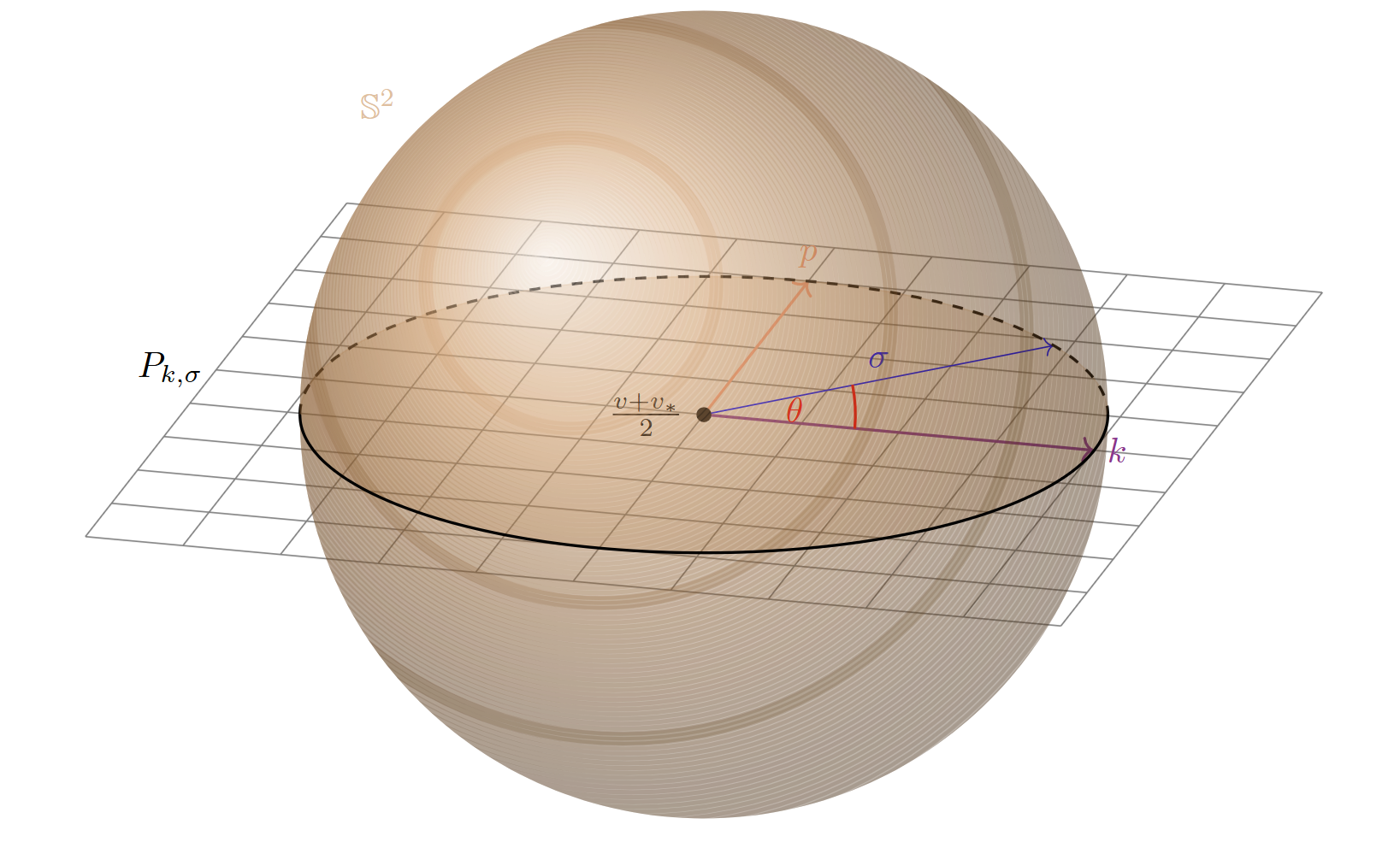
Wasserstein gradient flows represent a class of time-evolving PDEs modelling phenomena such as crowd motion, tumour growth, general diffusion, and has recent popular applications to machine learning. The theory has flourished since the early 2000s and remains an active field of research. Many of the previously described examples can be mathematically described from the microscopic (individual cells, particles, agents,...) or from the macroscopic (aggregate density or concentration of particles) viewpoints. Of particular interest is applying tools from optimal transport to rigorously connect these two descriptions from vastly different scales. Another line of investigation is investigating PDEs from the intermediary mesoscopic scale. These equations come from kinetic theory and relate to the famous Boltzmann and Landau equations.
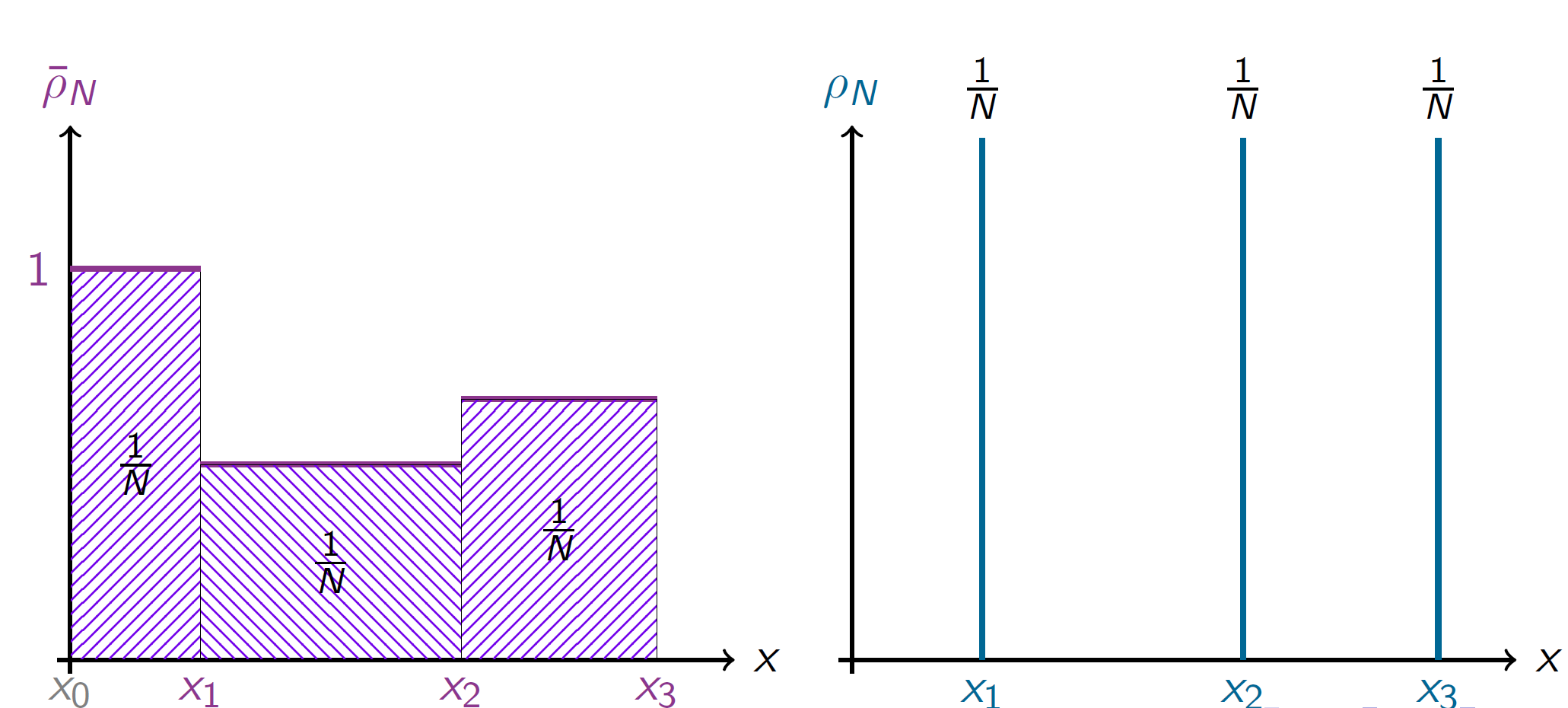
Within machine learning and statistics, a fundamental problem is approximating (continuous) probability densities with finitely many samples of this distribution. The classical strategy is to consider the empirical measure charging mass at these sample points. In many contexts, however, this may not be sufficient to recover the desired properties of the limiting density. For example, if the continuous density is expected to satisfy a pointwise upper bound, this does not make sense for the approximating empirical measure sequence. Better tools and approximations need to be developed in these cases, usually by leveraging additional structural properties of the problem at hand.
For many PDEs with a Wasserstein gradient flow structure, we are interested in developing particle methods which are accurate and efficient to implement. The theory and application of this method appears in mathematical physics and machine learning. The continuity equation structure of gradient flows gives rise to the notion of Lagrangian characteristics which are highly amenable to trajecting particle trajectories. The two main differing approaches are the blob method versus direct Lagrangian techniques. The blob method consists in regularizing the associated internal energy functional corresponding to the gradient flow structure. This regularization procedure deliberately breaks the diffusion allowing for particles to remain particles in the evolution of the regularized PDE. The price to be paid is quantitative convergence of the particle method to the original PDE. Currently, there is a large gap between error estimates guaranteed by theory (exponential number of particles) and those observed in numerical experiments (polynomial number of particles). Resolving this gap is one aspect of the research in this direction. Direct Lagrangian techniques avoid the previously described regularization procedure by investigating the equation for the characteristics. This method is more physically meaningful than the blob method and one does not have to deal with the interplay between the number of particles and regularization parameter. However, this approach faces major difficulties in spatial dimensions larger than one. In one dimension, the quantile function directly links a probability measure with its associated random variable as an isometry between Wasserstein and Lebesgue space. This general approach is not so clear in higher dimensions.
My PhD thesis
As an applied mathematician, my main interest is the study of Partial Differential Equations (PDE) for modelling physical phenomena. In particular, the focus of my PhD thesis is on the gradient flow structure of the spatially homogeneous Landau-Fokker-Planck equation $$\partial_t f(t,v) = \nabla \cdot \left(f(v)\int_{\mathbb{R}^3}f(v_*) |v-v_*|^{2+\gamma} \left[I - \frac{v \otimes v}{|v|^2} \right](\nabla \log f(v) - \nabla \log f(v_*))dv_* \right), \quad \gamma \in [-4,0]. $$
You can read more about the Landau equation and its relation to the famous Boltzmann equation here.